Naturia · The 3-Phase Calm System
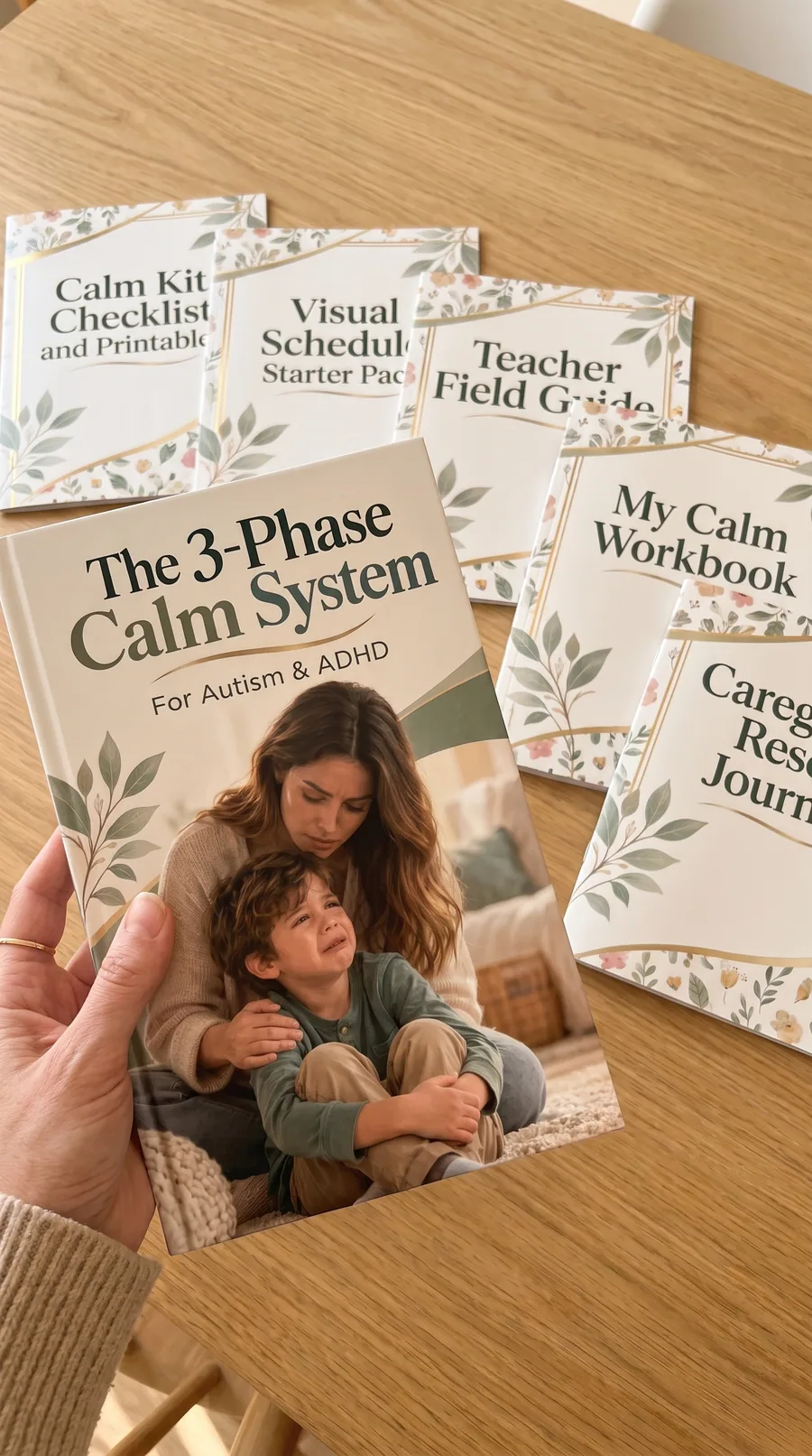
A step-by-step protocol for what to do before, during and after a meltdown — at home and in the classroom. Written for parents and teachers of autistic and ADHD children, with no jargon and nothing to improvise in the moment.
Instant access · Secure checkout · 7-day guarantee
What to look for
Children with autism and ADHD don’t choose to ignore instructions. They have a brain that processes information differently. Pay attention if you notice:
By age
Meltdowns rarely look the same at four as they do at twelve. Recognising the pattern for your child’s stage is what lets you step in earlier, while it still makes a difference.
Can’t sit through a story. Switches activity every few minutes. Struggles with the rules of simple games. Goes from calm to inconsolable with no visible middle step.
Leaves materials at home or at school. Takes far longer than classmates on homework. Holds it together all day, then falls apart the moment they walk through your door.
Grades drop even when they understand the material. Can’t study alone. Frequent conflict with teachers, and shutdowns that look like refusal rather than overwhelm.
The system
Most advice treats a meltdown as a single event to survive. This splits it into three separate jobs, each with its own moves. You stop improvising, because you always know which phase you’re standing in.
Spotting the build-up and adjusting the environment while your child can still use words. Most of the work lives here, and it’s the part almost nobody teaches.
What to say, what to stop saying, and where to put your body. A short, ordered sequence you can follow when you have no capacity left to think.
Rebuilding the relationship once the storm passes, and turning each episode into information that makes the next one less likely.
We are collecting the first reviews from parents and teachers. If it helped at home or in your classroom, tell us in a couple of lines — and say how you would like to be credited.
What’s inside
Built as a progression, not a library. You start at Volume 1 and move forward without deciding anything on your own.
What a meltdown is, what it isn’t, and why it is not a tantrum — so you stop responding to the wrong thing.
Reading the build-up, lowering the sensory load, and the changes to the day that stop many episodes before they start.
The ordered sequence to follow while it is happening, including what to stop saying.
Reconnecting afterwards, handling your own guilt, and learning from the episode without turning it into a lecture.
Turning the three phases into one written plan your whole household follows the same way.
The same plan translated for school, in a form you can hand to a teacher without a meeting.
Included at no extra cost
The volumes explain the system. These are what you stick on the fridge, hand to a teacher, or fill in at the end of a hard day.
Everything that goes in the kit, ready to print and assemble this week.
USD 5Free
Ready-made cards and boards so the day is something your child can see, not just hear.
USD 4Free
A short handout you can give to school without needing a meeting first.
USD 6Free
A child-facing workbook for naming feelings and choosing a strategy, at their level.
USD 3Free
For the part nobody plans for: your own recovery after a hard episode.
USD 5Free
Total value of the 5 bonuses: USD 23
Included free with the system. Not sold separately.
The complete system
Total valueUSD 54
Today you pay
USD 26.99
You save USD 27.01 · 50% off
Instant accessSecure checkout7-day guarantee
Prices are in US dollars (USD). If you’re outside the United States, your bank converts to your local currency automatically at the rate of the day.
Before you buy
No. This is educational material. It does not diagnose, treat or replace assessment, therapy or follow-up from a qualified professional who knows your child.
It is meant to sit alongside professional support, not instead of it. If you have concerns about your child’s development, behaviour or safety, speak to their paediatrician, therapist or school support team.
You get a confirmation email with your access right after checkout. The 6 volumes and 5 bonuses are downloadable PDFs.
Read them on a phone, tablet or computer, or print them — the bonuses are designed to be printed. This is a digital product; nothing ships to you.
Yes. The system is organised around what happens before, during and after an episode of overwhelm, which doesn’t depend on having a diagnosis on paper. It covers both autism and ADHD, and is written mainly for children aged roughly 4 to 14.
That said, it isn’t a substitute for assessment. If you suspect autism or ADHD, a proper evaluation is still worth pursuing.
It varies, and anyone who gives you a fixed number is guessing. Some families notice the Before Phase changes within a couple of weeks; for others it takes longer, and some episodes continue regardless.
What the system is designed to give you is a consistent response, which is the part you can actually control.
You have 7 days. Email support@naturiasalud.com and we’ll refund you in full — no form, no questions.
7-day guarantee
Open the volumes. Print the bonuses. Try the Before Phase for a week. If it isn’t what you expected, email us within 7 days and we’ll refund you in full. No forms. No questions. No awkwardness.
Strategies at home help, but some situations need a specialist. Speak to a paediatrician, child psychiatrist or psychologist if you notice persistent distress, withdrawal or anxiety; escalating aggression or behaviour that puts your child or others at risk; or a sharp, sustained drop at school despite support.
If your child is in immediate danger of harming themselves or anyone else, call your local emergency number now. This material is not for emergencies.
6 volumes + 5 printable bonuses + a home plan and a classroom plan — for USD 26.99.
Instant access · Secure checkout · 7-day guarantee
This material is educational and informational only. It does not diagnose or treat any condition and does not replace assessment, therapy or follow-up from a qualified professional familiar with your child. Autism and ADHD should be diagnosed by a qualified specialist following a full clinical evaluation. If your child is in immediate danger, call your local emergency number.